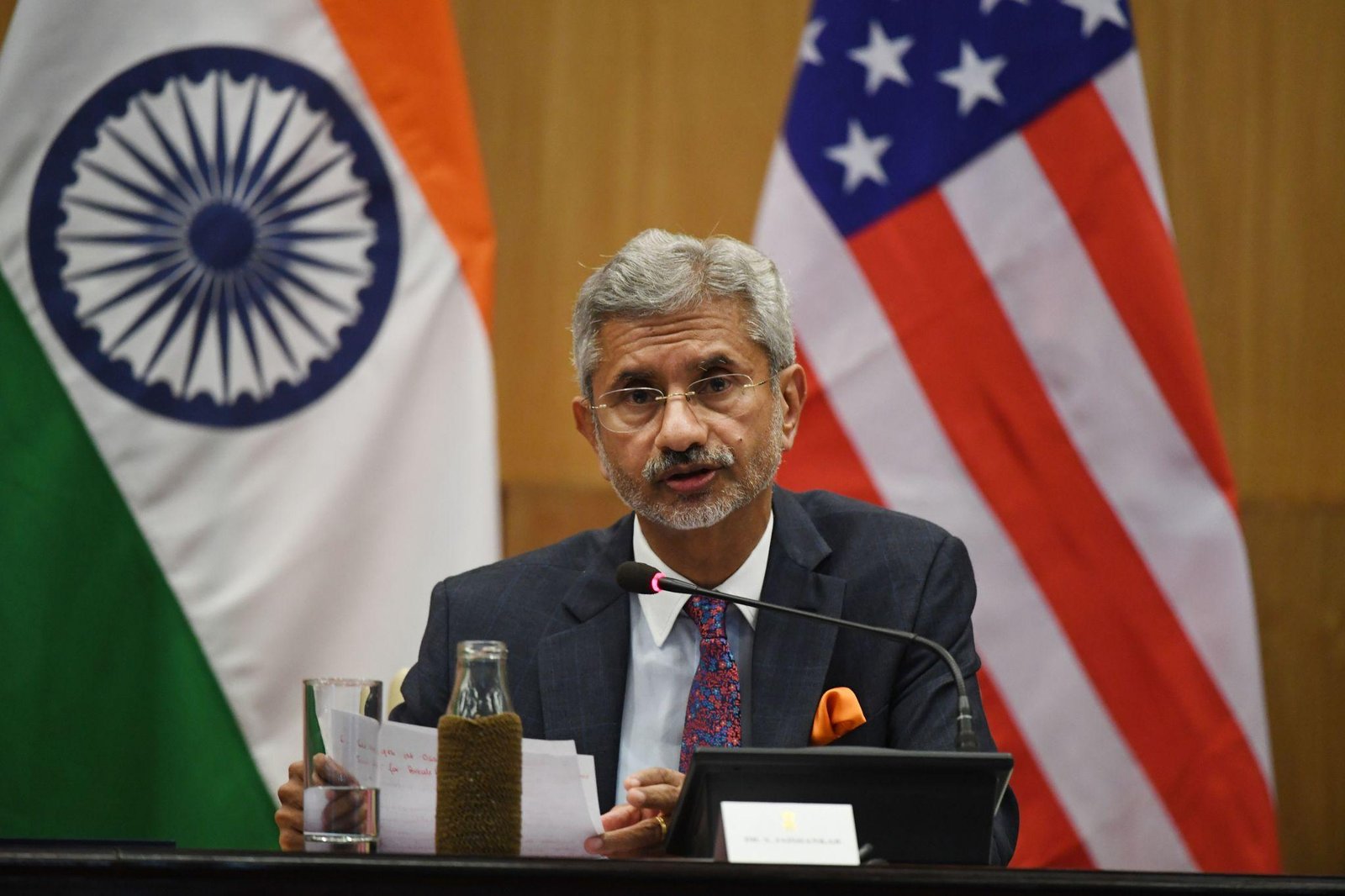
India’s External Affairs Minister Subrahmanyam Jaishankar has responded sharply to comments by a senior official from the United States who reportedly described India as an emerging “economic rival,” stating that India’s rise will ultimately be determined by its own policies and strategic choices.
Jaishankar emphasised that India’s growth trajectory is not defined by how other countries perceive it, but by domestic priorities, economic reforms, and long-term national strategy.
The comments come at a time when India’s expanding economy and geopolitical influence are reshaping global power dynamics, even as New Delhi continues to deepen strategic cooperation with Washington in areas such as defence, technology, and trade.
India’s growth driven by its own choices
Speaking on the evolving global order, Jaishankar suggested that India’s emergence as a major economic power is the result of internal reforms and long-term development strategies rather than external competition.
He noted that countries inevitably interpret the rise of others through their own strategic lens, but emphasised that India’s focus remains on national development and global engagement rather than rivalry.
India has emerged as one of the fastest-growing major economies in recent years, with growth forecasts from institutions such as the International Monetary Fund projecting the country to remain among the world’s top expansion engines in the coming decade.
The Indian economy is currently valued at roughly $3.7 trillion, and policymakers aim to expand it to $5 trillion within the next few years, a milestone seen as central to India’s ambition of becoming a major global economic powerhouse.
Strategic partnership with the US continues
Despite occasional differences in strategic outlook, India and the United States have steadily strengthened ties over the past decade across defence, technology cooperation, and supply chain resilience.
The two countries are key partners in several geopolitical initiatives in the Indo-Pacific region and have expanded collaboration in areas including advanced semiconductor technology, critical minerals, and emerging technologies.
Analysts note that Washington increasingly views India as a critical partner in maintaining stability in the Indo-Pacific while also recognising its growing economic influence on the global stage.
This dual perception — partner and competitor — reflects the complex nature of modern geopolitics, where countries often collaborate in strategic domains while simultaneously competing in economic and technological spheres.
India’s expanding global influence
India’s economic rise has been accompanied by growing diplomatic engagement across regions, from the Indo-Pacific to Europe and the Middle East.
New Delhi has positioned itself as a key voice representing the Global South while simultaneously strengthening relations with major Western economies.
The country’s expanding digital economy, manufacturing push, and infrastructure investments have contributed to stronger economic momentum, making India an increasingly important player in global supply chains.
Major policy initiatives aimed at boosting domestic manufacturing and technology development have also helped attract significant international investment in sectors such as electronics, semiconductors, and renewable energy.
Navigating competition and cooperation
Experts say Jaishankar’s remarks reflect India’s broader diplomatic strategy of maintaining strategic autonomy while engaging with multiple global powers.
New Delhi has consistently emphasised that it does not view international relations through a binary framework of alliances or rivalries, preferring instead to pursue partnerships based on mutual interests.
As India’s economy continues to expand and its global role grows, such debates about competition and cooperation with major powers are likely to become more frequent.
For policymakers in both New Delhi and Washington, the challenge will be balancing economic competition with strategic collaboration in a rapidly evolving global order.
Jaishankar’s comments signal that India intends to chart its own course in that environment — focusing on domestic growth, global engagement, and long-term national interests rather than external labels.