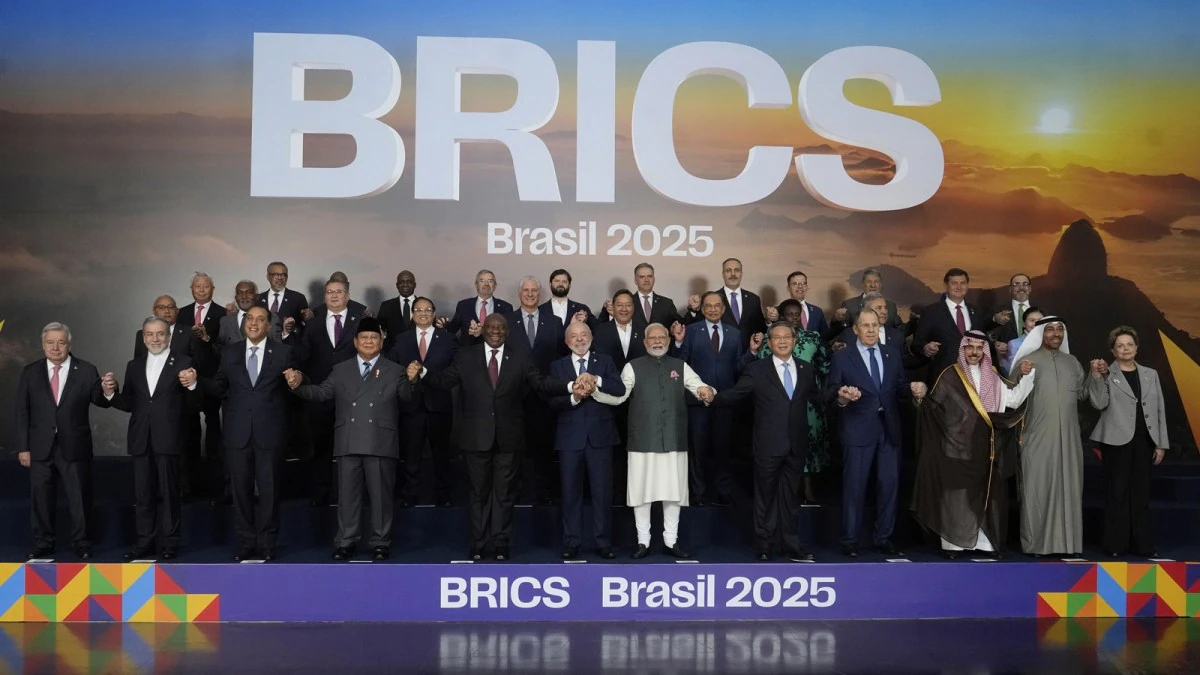
India has distanced itself from a unified position within the BRICS bloc, marking a significant strategic divergence from key partners including China and Russia. The move underscores New Delhi’s increasingly independent foreign policy as it navigates intensifying global polarization.
The development highlights India’s effort to balance its role within BRICS while protecting its economic and geopolitical interests — particularly amid rising tensions between major global powers.
The Strategic Context
BRICS — comprising Brazil, Russia, India, China, and South Africa — was formed to amplify the voice of emerging economies in global governance.
In recent years, the bloc has:
- Expanded membership discussions
- Explored alternatives to dollar-dominated trade systems
- Pushed for reforms in global financial institutions
However, India’s recent stance signals discomfort with proposals perceived as overtly confrontational toward Western institutions.
Why India Is Diverging
1. Strategic Autonomy
Under Prime Minister Narendra Modi, India has consistently emphasized “strategic autonomy” — avoiding formal alignment with either Western powers or rival blocs.
While BRICS promotes multipolarity, some recent initiatives have leaned toward positioning the bloc as a counterweight to US-led institutions. India appears cautious about being drawn into an explicitly anti-Western framework.
2. Economic Considerations
India’s trade and investment flows are deeply intertwined with Western economies:
- The United States remains one of India’s largest export markets
- European markets are key destinations for Indian services exports
- Foreign direct investment from Western nations remains critical
A sharp geopolitical tilt within BRICS could complicate these economic relationships.
3. China Factor
India’s unresolved border tensions with China add another layer of complexity. While both countries share BRICS membership, bilateral mistrust limits the depth of alignment.
New Delhi is wary of initiatives that could enhance Beijing’s leadership position within the bloc.
Implications for Global Markets
1. Reduced Probability of Immediate De-Dollarization
Markets have closely tracked BRICS discussions around alternative payment systems and reduced reliance on the US dollar.
India’s divergence reduces the likelihood of:
- A unified BRICS currency initiative
- Rapid institutional alternatives to the IMF or World Bank
- Coordinated financial decoupling from Western systems
This could ease short-term volatility in currency markets.
2. Stability Signal for Investors
India’s balanced approach may reassure global investors concerned about fragmentation of global trade architecture.
- Indian equities could benefit from continued capital inflows
- Sovereign bond markets may remain stable
- Currency volatility risks may be moderated
However, internal fractures within BRICS could introduce long-term uncertainty regarding the bloc’s cohesion.
Impact on India
Economic Positioning
India aims to position itself as:
- A leader of the Global South
- A manufacturing alternative to China
- A strategic partner to Western economies
Maintaining flexibility within BRICS allows India to engage multiple power centers without sacrificing economic growth ambitions.
Energy and Trade Dynamics
India relies on energy imports from diverse partners, including Russia. A balanced stance enables New Delhi to:
- Continue discounted energy purchases
- Avoid sanctions exposure
- Preserve diplomatic leverage
This pragmatic approach has become central to India’s foreign policy calculus.
Impact on Investors
Equity Markets
Investors may interpret India’s position as:
- A sign of policy predictability
- Reduced geopolitical overexposure
- Continued openness to Western capital
Sectors likely to benefit include:
- IT services
- Manufacturing
- Infrastructure
- Renewable energy
Currency and Bonds
A neutral geopolitical posture supports:
- Stable rupee outlook
- Controlled inflation risk via stable energy access
- Continued foreign portfolio investment flows
Impact on Consumers
For Indian consumers, the immediate effects are limited. However, medium-term implications include:
- Stable import prices if geopolitical risks remain contained
- Continued access to global technology platforms
- Sustained economic growth trajectory
In contrast, deeper bloc polarization could have raised costs for imported goods and financial services.
Broader Geopolitical Significance
India’s divergence illustrates a larger structural trend: emerging powers are unwilling to operate strictly within binary geopolitical frameworks.
Unlike the Cold War era, today’s global order is characterized by:
- Issue-based alignments
- Economic pragmatism
- Strategic hedging
India’s approach reflects a preference for flexible multilateralism rather than bloc-based confrontation.
Future Outlook
Several scenarios could unfold:
1. Managed Differences Within BRICS
The bloc continues cooperation on development finance and trade without ideological confrontation.
2. Structural Fragmentation
Diverging priorities between members weaken institutional coherence.
3. Selective Alignment
Members collaborate on economic issues while avoiding unified geopolitical positioning.
Given India’s economic trajectory and global ambitions, the most probable path is calibrated participation — neither full alignment nor disengagement.