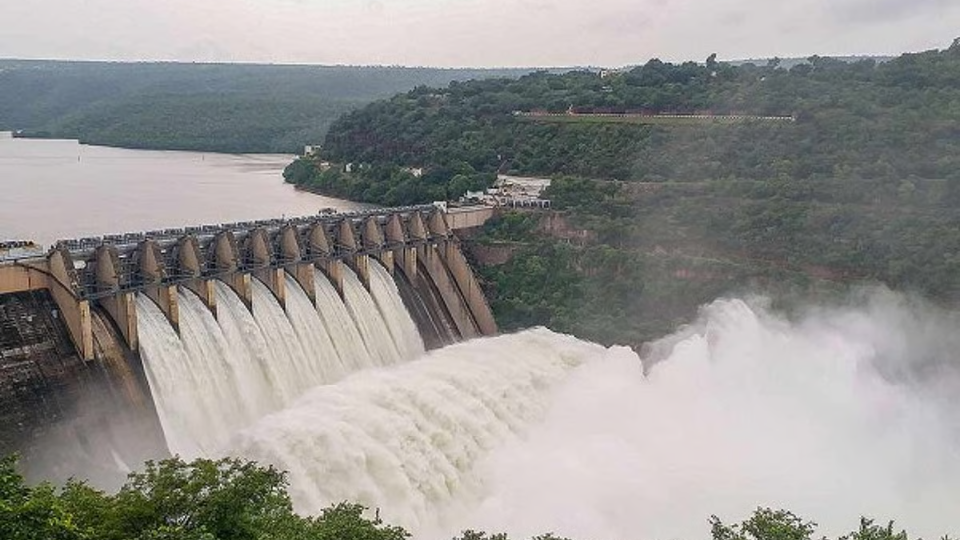
Once operational, the dam will allow India to divert surplus Ravi water to Punjab and Jammu and Kashmir instead of letting it flow into Pakistan.
Ahead of the summer season, India is likely to stop the flow of surplus water from the Ravi River to Pakistan once the Shahpur Kandi Dam becomes operational, according to Jammu and Kashmir minister Javed Ahmed Rana. The project aims to reduce water shortages in drought-prone areas and improve irrigation, NDTV reported, quoting the minister.
“Excess water to Pakistan will be stopped. It has to be stopped. Kathua and Samba districts are drought-hit areas, and this project, which is our priority, is being built for the Kandi region,” the minister said.
As summer approaches, Pakistan could face increased water pressure if India uses more of the eastern rivers under its control.
The minister said that work on the Shahpur Kandi Dam, located on the border of Punjab and Jammu and Kashmir, has picked up speed after India put the Indus Waters Treaty in abeyance. He added that the project is now close to completion.
“Once operational, the dam will allow India to divert surplus Ravi water to Punjab and Jammu and Kashmir instead of letting it flow downstream into Pakistan. The project is expected to be completed by March 31, and the diverted water will be used in the drought-affected districts of Kathua and Samba,” Rana said.
What Is the Shahpur Kandi Dam Project?
At present, surplus water from the Ravi River flows through Madhopur into Pakistan, which is the lower riparian country. The Shahpur Kandi Dam aims to redirect this unused water for use within India.
The project was first planned in 1979 to stop excess Ravi water from flowing into Pakistan. Former Prime Minister Indira Gandhi laid its foundation stone in 1982. However, construction stopped due to disputes between the governments of Punjab and Jammu and Kashmir. In 2008, the project was declared a national project.
The total cost of the dam is Rs 3,394.49 crore. Punjab is contributing around Rs 2,694.02 crore (about 80 per cent), while the central government is funding the remaining Rs 700.45 crore.
The dam will be 55.5 metres high and will include a 7.7-km-long hydel channel.
Officials said the project will help irrigate nearly 5,000 hectares of land in Punjab and more than 32,173 hectares in the Kathua and Samba districts of Jammu and Kashmir.
Citing former irrigation minister Taj Mohideen, the report stated that the Indus Waters Treaty does not regulate this dam because India has full rights over the Ravi River.
Why Did India Put the Indus Waters Treaty in Abeyance?
On April 23, 2025, a day after 26 civilians were killed in a terror attack in Pahalgam, India formally put the Indus Waters Treaty in abeyance. It also linked future water cooperation with Pakistan to its position on terrorism.
The decision came alongside Operation Sindoor and marked a shift in India’s policy towards Pakistan.
Pakistan depends heavily on the Indus river system. Nearly 80–90 per cent of its agriculture relies on these waters, and the country’s storage capacity covers only about one month of water flow.
Under the treaty, Pakistan had rights over the Indus, Jhelum, and Chenab rivers, while India had rights over the Ravi, Beas, and Sutlej rivers.
With the treaty currently in abeyance, the government has moved ahead with several hydroelectric projects in the Indus basin. These include Sawalkote, Ratle, Bursar, Pakal Dul, Kwar, Kiru, and Kirthai I and II. Work on the Sawalkote project has also been sped up recently.
Also Read : RVNL Wins ₹1,200 Crore Contract for Northern Railway Project