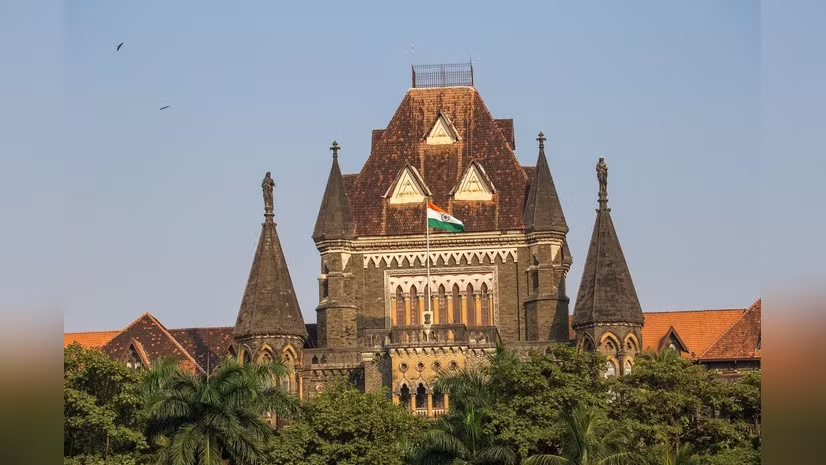
The Bombay High Court has declined a petition seeking permission for offering Namaz at a public ground in Mumbai, siding with the local police’s decision to prohibit the gathering citing security and administrative concerns. The court observed that while the right to practice religion is constitutionally protected, it is not absolute and can be subject to reasonable restrictions in the interest of maintaining public order.
The petition had challenged the decision of the Mumbai Police to deny permission for congregational prayers at the site, particularly during Friday Namaz. Petitioners argued that the space had historically been used for prayers and that the restriction infringed on their religious freedoms.
Court Balances Religious Freedom With Public Order
During the hearing, the bench examined whether allowing a large gathering for prayers in the open area could create logistical or security complications. Authorities had informed the court that the location had become a sensitive zone due to traffic movement and crowd management concerns.
The court noted that constitutional rights, including the right to freely profess and practice religion under Article 25, must coexist with public safety considerations. Judges emphasized that the administration retains the authority to regulate public gatherings if they pose potential law-and-order challenges.
Accordingly, the bench held that the police decision could not be termed arbitrary and declined to intervene. The order effectively prevents congregational Namaz from being conducted at the disputed ground unless authorities grant explicit permission in the future.
Petitioners Cite Longstanding Practice
Petitioners argued that local residents had been offering Namaz at the ground for several years without significant incidents. They contended that the sudden denial of permission represented an unjustified change in administrative stance.
Legal representatives for the petitioners maintained that alternative spaces were either too small or located far from the residential cluster, making it difficult for worshippers to gather conveniently for Friday prayers.
However, the court maintained that the availability or convenience of a location cannot override security considerations if the authorities deem a public gathering risky.
Police Stand: Security and Crowd Management
Officials from the Mumbai Police informed the court that the area in question had experienced rising congestion and logistical challenges during previous gatherings.
Police submissions highlighted concerns including:
- Potential traffic disruption in nearby roads
- Crowd control difficulties during peak hours
- The risk of communal tension if large gatherings were permitted in sensitive zones
Authorities also pointed out that worshippers have access to nearby mosques where prayers can be offered without requiring public road space or open grounds.
The administration argued that its decision was purely administrative and aimed at preventing future law-and-order complications rather than targeting any particular religious practice.
Legal Context: Regulation of Religious Gatherings
Courts in India have repeatedly held that while religious freedom is a fundamental right, public spaces cannot be permanently appropriated for religious activities.
Several judicial rulings in recent years have addressed disputes over the use of roads, parks, or public grounds for religious events, including prayers, processions, and festivals. Courts have generally favored regulatory oversight by local authorities to ensure that civic infrastructure is not disrupted.
In this case, the court reiterated that constitutional protections must operate within the framework of public order and administrative feasibility.
Legal experts note that the judgment aligns with broader judicial trends emphasizing the need for designated places of worship rather than the unrestricted use of public land for religious activities.
Political and Social Reactions
The ruling has sparked debate across political and civil society circles. Some groups welcomed the decision, arguing that public spaces should remain accessible to all and should not be converted into sites of regular religious congregation.
Others expressed concern that restrictions could disproportionately affect communities that rely on open spaces due to limited mosque capacity.
Community representatives have called for dialogue with authorities to identify suitable alternatives that allow worship without causing administrative difficulties.
What Happens Next
Following the court’s refusal to grant relief, petitioners may explore legal options including filing an appeal before the Supreme Court of India.
In the meantime, local authorities are expected to continue enforcing restrictions on public congregational prayers at the disputed site. Officials have indicated that permission requests for religious gatherings will be evaluated on a case-by-case basis depending on security conditions and logistical feasibility.
The case highlights the ongoing challenge faced by urban administrations in balancing religious freedoms with public infrastructure management in densely populated cities like Mumbai.
As Indian cities continue to grow and public spaces become increasingly contested, courts are likely to play a critical role in defining the limits of religious activity in shared civic areas.